Posts Tagged ‘Custom’

UPDATE #2: NTC ’40 Ford Pickup

Thursday, December 13th, 2012

Thought we’d post another update on our shop project, a 1940 Ford Pickup, as we’ve made some progress since the last update. If you missed the first post, make sure to check it out here so you can see some “before” pics, and check out this previous update to see some of the metal fab and patch work.

With lots of customer cars keeping us busy, we had to put this project on hold for a while but finally worked out some time to dust things off and go at it again. After contemplating direction for a bit, we determined that we’d be able get it on the road a lot more quickly by nixing the flathead and going with a different setup. We had an old 327 on hand that came out of a truck and was an obvious choice to get this truck rolling.

First was to get the frame on the rack and level it out. We didn’t set it at ride height as we were just checking for any racking in the frame and to get the rear installed:

img_1902-small

We are using 49-54 Chevy truck front springs for a rear parallel system. To mock up, we centered and clamped the rear hangers while waiting for the new bushing bolts to arrive; at that time we will remove a few leaves and adjust the wheels to the fenders before drilling the permanent location holes:

img_1903-small

The spring pads on the axle may have to be relocated inboard about 1/2″ – 1/4″ on each side but it’s almost a perfect fit:

img_1904-small

Up front we had removed about 4 leaves and used a 36 4″ dropped axle, but wanting more, we reversed the eyes using the shop press method. It’s a really simple technique that gives you about another inch:

img_1910-small

We placed the cab back on the frame to get an idea of where things stood. You can also see in this pic that we added 2″ blocks:

img_1908-small

We jacked the front end up to simulate being under load and decided to go ahead and raise the front cross member up 2″:

img_1907-small img_1911-small

Upon inspection, the frame was about one inch higher on the driver’s side. The bumper probably got tapped at some time in its life as all the twist was just in the front frame horn area. Using a come-along and torch, we massaged the twist out and made everything square:

img_1922-small

Next we cut one side off a piece of 3/16″ thick walled 2″ ID square pipe to use as the new spring pocket. We then measured an 1 1/2″ rise in the cross member which was cut out so that in order to push the square pipe into place. Once it was level side to side, we put in 5 to 6 degrees tilting back for the spring:

img_1923-small

And welded it in:

img_1925-small

Now that the top was taller, we wanted to bring the bottom up so that it would look stock when finished. Also the spring u-bolts were now as long as the cross member was tall. So we cut out the bottom lip and sectioned it up so that the cross member would stand at about 2 3/4″. The spring pack is 2″ tall with some leaves removed; if it seems that the truck will wind up too low, we can add back a leaf or two:

img_1932-small img_1934-small

We then cut off the outer pieces and leveled across:

img_1936-small

Resulting in:

img_1937-small img_1938-small

Next, on to X-member and engine mock-up! Stay tuned for Update #3…and visit our 1940 Ford Pickup photo gallery to see all of the build pics for this project.

Hot Rod, Classic & Muscle Car Mechanic Services

Tuesday, December 11th, 2012

Just a reminder that in addition to complete restoration services, we offer a wide range of mechanical services specifically for Hot Rods, Classics and Muscle Cars. Contact us for ongoing maintenance needs, tune-ups, repairs, component swaps, and more.

  • Regular maintenance & upkeep
  • Engine & transmission swaps and rebuilds
  • Disc brake conversions
  • Lowering
  • Metal fabrication
  • Rear end (posi) rebuilds
  • Gear changes
  • Suspension mods (4-bars, hairpins, axle drops, airbags, Mustang II clips, etc.)
  • Wiring harness installation, repairs and troubleshooting
  • Classic Auto Air conditioning system installation

As a dedicated resto/rod shop, we know how to treat your car and offer expertise with all types of vintage technology. We can also help locate hard-to-find parts for jobs in progress and will take extra care to protect your paint and unique components. Visit our Mechanical Services page for additional pics and information.

And of course, if your project requires more than mechanical attention, we are here to help with  in-house media blasting, welding, fabrication, panel replacement, and award-winning paint and body. Contact us today to see how we can get you back on the road or help improve your ride.

img_1628

1952 Chevy Styleline

1956 Pontiac Catalina

22_054sm

1968 Chevy Camaro

1969 Plymouth Road Runner

Candy Coated Chevelle

Wednesday, December 1st, 2010

We had our work cut out for us to restore this 1969 Chevelle – or should we say, we cut it out ourselves. The back half was completely rotted and had to be scrapped, frame rails and all. After stripping what was no good, we welded in new cross members, rails, trunk pan, full floor pan, quarter panels and wheel tubs. Some grinding and a little bodywork later, she was ready for color.

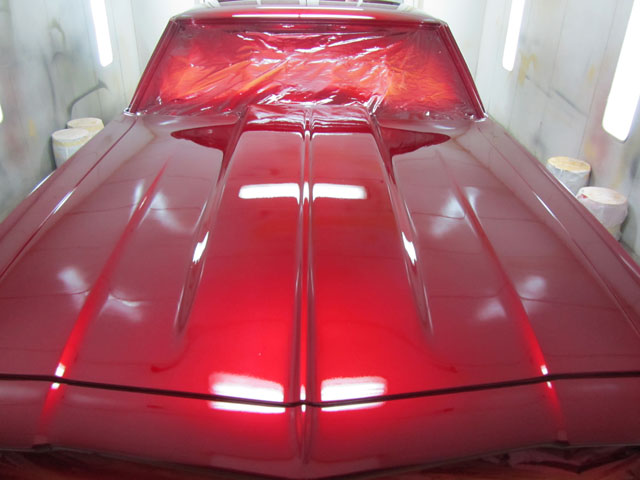
On a typical paint job, all panels are hung and gapped, then removed from the car before painting and sprayed separately from the body. However, this Chevelle was getting treated to a custom candy application, so we removed them, cut in all jambs, then re-hung and gapped them out in order to allow the painter to build the candy up uniformly across the whole surface of the car.

Using House of Kolor products, we sprayed a Shimrin Metallic Solar Gold base, followed by Kandy Apple Red, and finished out with PPG High Solids clear coat to give it a nice, deep shine. Once color sanding and buffing was done, she was begging to see the sun, and we were happy to oblige. This one may turn a few heads when cruising season rolls around.

And some step-by-step videos as we laid down the paint:

LIVE: Candy Apple Red Chevelle

Thursday, October 14th, 2010

Wanna take a break from work today? Love to watch something come together? Looking forward to the classes we will be offering soon?

We are excited to show our family of fans a behind-the-scenes look at laying down a complete candy paint job on a 1969 Chevelle, live on our Facebook page today! Don’t worry if you’ll be busy behind the desk because we’re going to update throughout the day with pictures and video as we go. So stay tuned for the latest postings and chatter!

*UPDATE: Final pics and videos available here!*

Final primer 1

Postwar Mopar Revival: 1947 Dodge

Monday, August 2nd, 2010

Marketed as the “smoothest car afloat,” the 1947 Dodge D24 Custom boasted power, speed, low maintenance and a spacious interior. With those features in mind, we set out to transform this fatigued stone beige sedan into a sleek black powerhouse and get her back in the game. Highlights of this model include an interestingly modern push-button start, a smooth, reliable flathead 6 engine, and Chrysler’s innovative Fluid Drive transmission, embellished with suicide doors and a dramatic butterfly hood. All rebuilt components and a new two-stage coat were just what was needed to put the spirit back in this car.

With the high demand following WWII, the popular D24 cost about $1500 new in 1947. While you may never find that on a sticker again, driving a vehicle like this makes a classic style statement today that’s definitely priceless.